
 info@fstindia.in
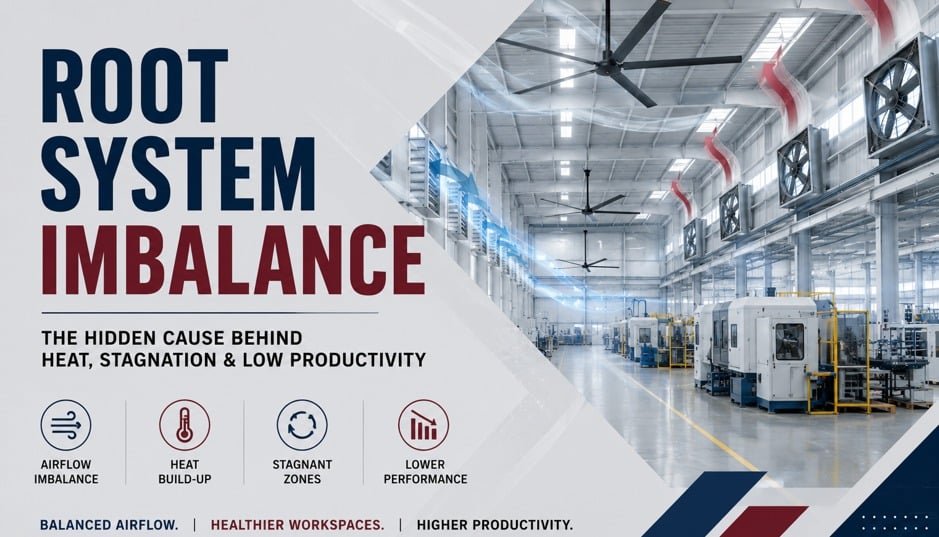
Root System Imbalance in Industrial Ventilation: The Hidden Cause of Heat, Poor Air Quality, and Productivity Loss
Introduction
In industrial facilities, management often focuses on visible symptoms such as excessive heat, stagnant air, worker discomfort, dust accumulation, high humidity, or rising energy bills. However, these symptoms are rarely the actual problem. They are usually manifestations of a deeper issue within the ventilation ecosystem known as Root System Imbalance.
The term “Root System Imbalance” is borrowed from biological systems where an unhealthy root network prevents a plant from absorbing water and nutrients effectively. Similarly, in industrial buildings, the ventilation “root system” consists of air inlets, exhaust points, airflow pathways, circulation systems, and pressure relationships. When this foundation becomes unbalanced, the entire indoor environment suffers.
Understanding and correcting Root System Imbalance is often the first step toward achieving a thermally comfortable, energy-efficient, and productive shop floor.
Understanding the Industrial Ventilation Root System
Every industrial building functions as a large breathing organism.
Just as the human body requires both inhalation and exhalation, a factory requires:
Air Intake (Inhalation)
Fresh air entering through:
- Louvers
- Windows
- Wall openings
- Fresh air units
- Ridge vents
Air Exhaust (Exhalation)
Contaminated or hot air leaving through:
- Exhaust fans
- Roof ventilators
- Ridge extractors
- Stack systems
Air Distribution Network
Movement of air through:
- HVLS fans
- Air circulators
- Jet fans
- Cooling systems
- Natural convection currents
When these three elements are properly balanced, the facility develops a healthy airflow ecosystem. When one element dominates or becomes restricted, Root System Imbalance develops.
What Creates Root System Imbalance?
1. Excessive Exhaust with Insufficient Fresh Air
This is one of the most common industrial mistakes.
Many facilities install multiple exhaust fans to remove heat but fail to provide adequate fresh air replacement.
As exhaust fans remove air faster than it can enter, the building develops excessive negative pressure.
Consequences include:
- Reduced exhaust performance
- Air starvation
- Door suction effects
- Dust infiltration through cracks
- Increased motor loading
- Reduced cooling effectiveness
The building literally struggles to breathe.
2. Excessive Air Supply with Inadequate Exhaust
The opposite condition also creates problems.
Large evaporative coolers or fresh air systems may introduce large volumes of air without sufficient exhaust capacity.
This creates positive pressure conditions resulting in:
- Heat accumulation near the roof
- Moisture build-up
- Condensation
- Poor contaminant removal
- Stagnant zones
Air enters but cannot leave efficiently.
3. Airflow Short-Circuiting
This occurs when incoming air exits before reaching occupied zones.
Examples include:
- Exhaust fans positioned directly opposite air inlets
- Cool air immediately escaping through roof openings
- Fresh air bypassing worker areas
Although airflow measurements may appear adequate, effective ventilation remains poor because the air never reaches the people who need it.
4. Stratification-Induced Imbalance
Heat naturally rises.
In high-bay industrial buildings, roof temperatures may exceed occupied-zone temperatures by 8°C to 15°C.
Without adequate destratification:
- Hot air becomes trapped near the ceiling
- Exhaust systems become less effective
- Cooling systems work harder
- Workers experience localized discomfort
The thermal root structure of the building becomes unstable.
5. Obstructed Airflow Paths
Modern factories often evolve over time.
New machines, partitions, storage racks, mezzanines, and process equipment can disrupt airflow pathways originally intended by the ventilation design.
The result is:
- Dead air zones
- Heat pockets
- Dust accumulation regions
- Uneven temperature distribution
The ventilation system may still operate, but airflow no longer reaches critical zones.
Technical Indicators of Root System Imbalance
Several measurable parameters reveal ventilation imbalance.
Temperature Mapping
Signs include:
- Temperature differences exceeding 3–4°C across the shop floor
- Persistent hot spots
- High roof temperatures
Air Velocity Mapping
According to industrial comfort studies, occupied zones should generally experience air movement between:
0.3 m/s to 1.5 m/s
depending upon temperature conditions.
Values below this range indicate stagnant regions.
Differential Pressure Measurement
Using digital manometers, engineers can identify:
- Excessive negative pressure
- Excessive positive pressure
- Pressure instability
Pressure imbalance is often the earliest indicator of root system dysfunction.
CO₂ Monitoring
Elevated CO₂ concentrations indicate inadequate fresh air exchange.
Typical industrial targets:
- Below 800 ppm: Excellent
- 800–1000 ppm: Acceptable
- Above 1000 ppm: Investigation required
Smoke Visualization Studies
Smoke tests remain one of the most effective diagnostic tools.
They reveal:
- Airflow direction
- Recirculation zones
- Short-circuit paths
- Dead zones
Problems that remain invisible on drawings become immediately apparent.
Impact on Productivity and Human Performance
Root System Imbalance is not merely an engineering issue.
It directly affects workforce productivity.
Research consistently demonstrates that elevated temperatures and poor air movement result in:
- Increased fatigue
- Reduced concentration
- Higher error rates
- Increased absenteeism
- Lower productivity
In manufacturing environments, even a 5–10% productivity loss can exceed the annual operating cost of a well-designed ventilation system.
Heat stress further increases the risk of:
- Dehydration
- Heat exhaustion
- Worker dissatisfaction
- Safety incidents
Thus, ventilation should be viewed as a productivity infrastructure rather than a utility expense.
Engineering Solutions for Correcting Root System Imbalance
Step 1: Conduct a Ventilation Audit
A professional survey should include:
- Temperature mapping
- Air velocity mapping
- Pressure measurements
- Heat source identification
- Airflow visualization
Without measurement, corrective action becomes guesswork.
Step 2: Balance Air Intake and Exhaust
A fundamental engineering rule states:
Air Removed ≈ Air Introduced
The building should neither starve for air nor become excessively pressurized.
A properly balanced airflow ecosystem creates stable operating conditions.
Step 3: Remove Heat at the Source
Instead of attempting to cool the entire building, prioritize source capture.
Examples include:
- Local exhaust systems
- Heat hoods
- Process extraction systems
- Thermal containment methods
Removing heat before it spreads dramatically improves efficiency.
Step 4: Improve Air Distribution
HVLS fans, air circulators, and airflow management systems should be used to:
- Eliminate dead zones
- Break thermal stratification
- Deliver airflow to occupied areas
The objective is controlled airflow distribution rather than simply increasing airflow volume.
Step 5: Implement Smart Monitoring
Modern sensor networks can continuously monitor:
- Temperature
- Relative humidity
- Air velocity
- CO₂
- PM2.5
- PM10
Real-time monitoring enables proactive correction before worker comfort deteriorates.
The Future: From Ventilation to Human-Centric Environmental Control
Traditional ventilation systems were designed primarily to remove contaminants.
Modern industrial facilities must go further.
The future lies in maintaining human thermal comfort through intelligent environmental management using:
- IoT sensors
- Smart controls
- Automated ventilation systems
- Predictive analytics
- Occupancy-based airflow management
Instead of measuring equipment performance, facilities will increasingly measure human comfort performance, creating healthier and more productive workplaces.
Conclusion
Root System Imbalance is often the hidden reason why industrial ventilation systems fail to deliver expected results. Excessive heat, stagnant air, dust accumulation, worker discomfort, and poor productivity frequently originate from an improperly balanced airflow ecosystem rather than inadequate equipment capacity.
A factory must be viewed as a living system that breathes. Fresh air intake, exhaust capacity, airflow distribution, and pressure relationships must operate in harmony. When these foundational elements are balanced, the facility achieves better thermal comfort, improved air quality, lower energy consumption, enhanced worker well-being, and higher productivity.
Before investing in additional cooling equipment, every facility should first ask a critical engineering question:
“Is our ventilation root system balanced?”
In many cases, correcting this hidden imbalance delivers greater benefits than adding more fans, coolers, or exhaust systems. It is often the most cost-effective path toward creating a productive, efficient, and sustainable industrial workplace.
A balanced ventilation system creates a productive shop floor.
Let Five Star Technologies help you optimize airflow, comfort, and energy efficiency with smarter industrial ventilation solutions.