
 info@fstindia.in
Introduction
Most industrial facilities invest significant capital in ventilation systems, roof exhausters, air circulators, HVLS fans, evaporative cooling systems, louvers, and fresh air systems. Yet many continue to experience worker discomfort, excessive energy consumption, poor indoor air quality, and productivity losses.
The reason is surprisingly simple.
Most ventilation systems are designed to operate at a fixed airflow rate throughout the year, while the environmental challenges affecting the shop floor change dramatically from season to season.
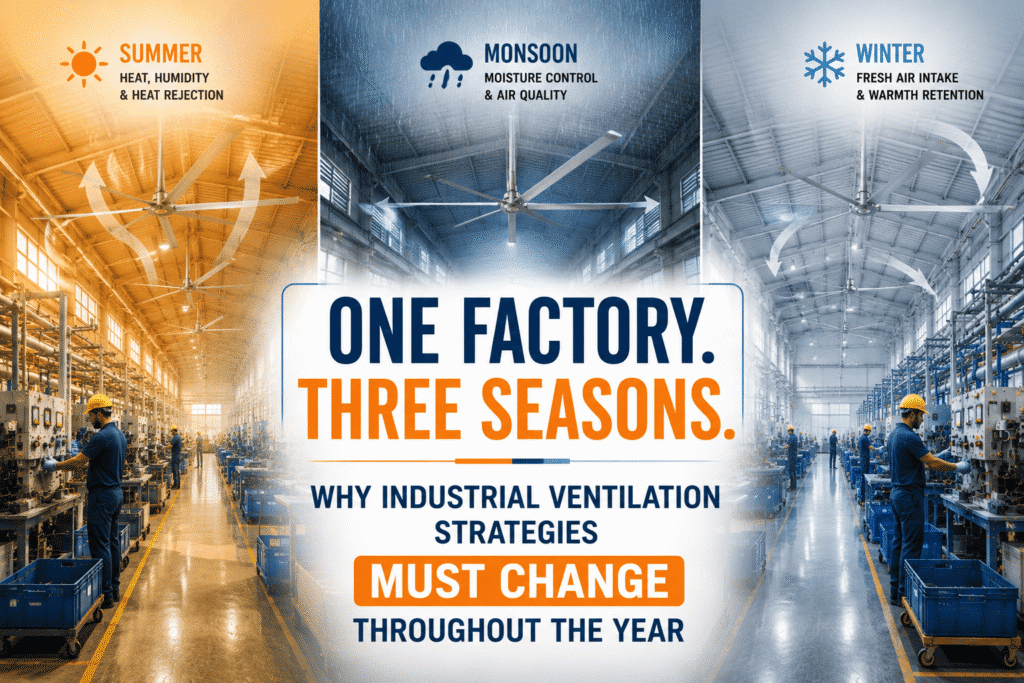
In Northern India, factories experience three distinctly different environmental conditions:
- Extreme summer heat (April–June)
- High humidity during monsoon (July–September)
- Cold winters (November–February)
Each season creates different heat transfer mechanisms, airflow requirements, and worker comfort challenges.
A ventilation strategy that performs effectively in May may be completely unsuitable in January.
The future of industrial ventilation lies not in installing larger fans but in deploying season-specific, demand-based ventilation strategies that respond dynamically to changing environmental conditions.
Understanding the Objective of Industrial Ventilation
Before discussing seasonal strategies, it is important to understand the true purpose of industrial ventilation.
Many engineers mistakenly believe ventilation is simply the process of moving air.
In reality, ventilation serves five primary objectives:
1. Heat Removal
Removing sensible heat generated by:
- Machinery
- Motors
- Furnaces
- Compressors
- Welding operations
- Lighting systems
- Solar roof heat gain
2. Contaminant Removal
Removing:
- Dust
- Fumes
- Smoke
- VOCs
- Process emissions
3. Fresh Air Replacement
Maintaining acceptable oxygen and CO₂ concentrations.
4. Moisture Control
Preventing excessive humidity and condensation.
5. Human Comfort
Maintaining acceptable conditions for worker productivity.
The relative importance of these objectives changes significantly across seasons.
Why Fixed-Speed Ventilation Systems Fail
Most industrial ventilation systems operate based on:
- Manual switching
- Fixed schedules
- Operator judgment
This approach ignores changing environmental conditions.
As a result:
- Summer airflow may be insufficient.
- Monsoon airflow may be excessive.
- 0.Winter airflow may waste energy.
The system becomes inefficient during most of the year.
Summer Ventilation Strategy: Heat Rejection Mode
The Challenge
During summer, industrial buildings experience multiple simultaneous heat loads
Solar Heat Gain
Metal roofs can reach:
- 60°C to 80°C surface temperatures
- Radiate heat continuously into the shop floor
Process Heat
Generated from:
- Injection molding machines
- Presses
- Furnaces
- Compressors
- CNC machines
- Electrical panels
Internal Heat Gains
Produced by:
- Workers
- Lighting systems
- Motors
- Material handling equipment
The cumulative effect often pushes indoor temperatures 5°C to 10°C above ambient.
Summer Ventilation Objective
The primary objective becomes:
Rapid Heat Extraction
The ventilation system must continuously remove accumulated heat before it becomes trapped inside the building.
Recommended Summer Strategy
High Roof Exhaust Capacity
Hot air naturally rises.
Effective summer designs maximize:
- Ridge ventilators
- Roof extractors
- Turbo ventilators
- Powered roof exhaust fans
to remove accumulated heat from the roof zone.
High Volume Air Circulation
HVLS fans help:
- Break thermal stratification
- Improve convective cooling
- Increase air velocity around workers
Even when temperatures remain high, increased air movement improves perceived comfort.
Controlled Fresh Air Intake
Adequate replacement air must enter through:
- Louvers
- Sidewall openings
- Fresh air fans
Without replacement air, exhaust systems become ineffective.
Evaporative Cooling Integration
Where climatic conditions permit, evaporative cooling systems can reduce incoming air temperatures significantly before entering the workspace.
Monsoon Ventilation Strategy: Humidity Management Mode
The Challenge
Many factories mistakenly increase ventilation during monsoon.
This often creates new problems.
Outdoor air may contain:
- Relative humidity above 80%
- High moisture content
- Lower evaporation potential
Introducing large quantities of humid air can actually worsen indoor comfort.
Monsoon Ventilation Objective
The objective shifts from heat removal to:
Moisture Management
and
Air Quality Maintenance
Common Monsoon Problems
Condensation
Occurs on:
- Metal surfaces
- Electrical panels
- Cold process equipment
Corrosion
Accelerated by prolonged moisture exposure.
Worker Discomfort
High humidity reduces sweat evaporation, making workers feel hotter than actual temperature conditions.
Mold Growth
Especially in storage areas and low-airflow zones.
Recommended Monsoon Strategy
Controlled Air Exchange
Avoid excessive air intake.
Ventilation rates should be optimized rather than maximized.
Continuous Air Movement
HVLS fans become extremely important.
Their role changes from cooling to moisture dispersion.
Air movement helps:
- Increase evaporation rates
- Prevent stagnant zones
- Reduce perceived discomfort
Humidity Monitoring
Install sensors for:
- Relative humidity
- Dew point
- Temperature
to continuously monitor environmental conditions.
Smart Ventilation Controls
Ventilation rates should automatically adjust based on:
- Indoor humidity
- Outdoor humidity
- Occupancy levels
- Process requirements
Winter Ventilation Strategy: Heat Retention Mode
The Challenge
Many factories unknowingly waste energy during winter.
Ventilation systems continue operating at summer airflow rates, exhausting valuable heat generated inside the facility.
Sources of Useful Winter Heat
Industrial facilities naturally generate heat from:
- Motors
- Compressors
- Production equipment
- Lighting
- Workers
This heat becomes an asset during winter.
Winter Ventilation Objective
The objective changes from:
Heat Removal
to
Heat Conservation While Maintaining Air Quality
Recommended Winter Strategy
Reduced Exhaust Operation
Ventilation should operate only to:
- Maintain air quality
- Remove contaminants
- Control CO₂ levels
Excessive exhaust should be avoided.
Optimized Fresh Air Intake
Only the minimum required fresh air should enter the building.
Air Recirculation
Where processes permit, recirculation of indoor air can significantly reduce heating losses.
Thermal Stratification Management
Warm air accumulates near the roof.
HVLS fans can gently destratify this air and push useful heat back to worker level.
This often improves comfort without any additional energy consumption.
The Rise of Demand-Based Ventilation
Modern industrial facilities are transitioning toward Demand-Based Ventilation (DBV).
Instead of operating ventilation systems continuously, airflow is adjusted according to actual requirements.
Parameters Used in Demand-Based Ventilation
Environmental Sensors
- Temperature
- Humidity
- Dew Point
- Air Velocity
Indoor Air Quality Sensors
- CO₂
- PM2.5
- PM10
- VOCs
Occupancy Sensors
- Worker density
- Operational activity
Process Sensors
- Machine heat load
- Production intensity
The Role of Industrial IoT in Seasonal Ventilation
The next generation of factories will rely on Industrial IoT platforms that continuously monitor environmental conditions across multiple zones.
These systems collect real-time data and automatically control:
- Roof exhaust fans
- HVLS fans
- Air circulators
- Fresh air systems
- Evaporative cooling systems
- Louvers
- Motorized dampers
The result is a dynamic ventilation ecosystem that continuously adapts to changing conditions.
Business Benefits of Season-Based Ventilation
Organizations implementing seasonal ventilation strategies typically achieve:
Improved Worker Productivity
Better thermal comfort improves concentration and reduces fatigue.
Reduced Heat Stress
Particularly during summer months.
Lower Energy Consumption
Equipment operates only when required.
Improved Indoor Air Quality
Consistent management of pollutants and contaminants.
Extended Equipment Life
Reduced moisture-related corrosion and overheating.
Enhanced ESG Performance
Lower energy intensity and healthier workplaces contribute directly to sustainability goals.
Conclusion
Industrial ventilation should no longer be viewed as a collection of fans and exhaust systems.
It should be viewed as a dynamic environmental management system.
In Northern India, summer, monsoon, and winter each present unique challenges that require different ventilation responses.
Factories that continue operating a single ventilation strategy throughout the year will experience unnecessary energy costs, reduced worker comfort, and lower productivity.
The future belongs to intelligent, sensor-driven, season-specific ventilation systems that deliver the right airflow, in the right location, at the right time, and in the right season.
Because ultimately, productivity is not determined by machinery alone.
It is determined by the environment in which people work.
Is Your Factory Using the Same Ventilation Strategy All Year?
Every season creates different ventilation challenges. Let our experts evaluate your facility and recommend the right solution for maximum efficiency, comfort, and productivity.