
 info@fstindia.in
Introduction
In industrial environments, shop floor heat discomfort is almost always blamed on high air temperature. As a result, corrective actions typically focus on increasing cooling capacity—adding air coolers, running industrial fans for longer durations, or lowering thermostat setpoints.
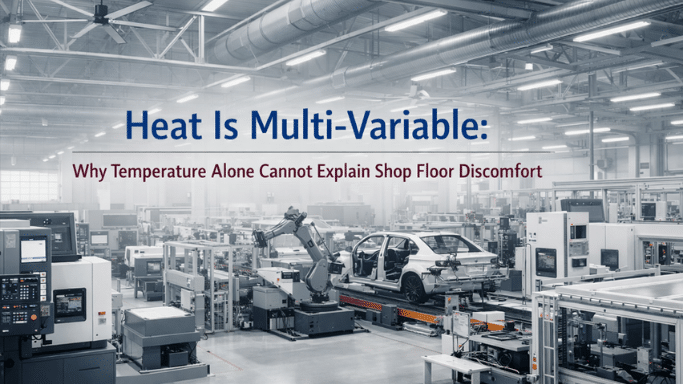
However, many factories experience a persistent paradox: energy consumption increases, yet worker comfort does not improve. The root cause is often overlooked but critical—industrial heat is a multi-variable phenomenon, not a single-temperature issue.
Engineering Perspective: How Humans Actually Perceive Heat
From a thermal comfort engineering standpoint, human heat perception is not determined by air temperature alone. Instead, it is governed by multiple interacting variables that collectively affect the body’s ability to dissipate heat.
Ignoring these interactions leads to:
Inefficient cooling strategies
Rising operational costs
Persistent worker discomfort
To design effective solutions, heat must be understood as a system-level challenge.
The Five Variables That Define Shop Floor Heat Discomfort
1. Air Temperature
Air temperature is the most commonly measured parameter, yet it is often misinterpreted.Two areas with the same temperature can feel drastically different due to other influencing factors. Temperature alone cannot explain discomfort patterns on an industrial shop floor.
2. Radiant Heat
Radiant heat is a major contributor in factories and warehouses.
Sources include:
Metal roofing sheets
Machinery surfaces
Furnace zones
Large wall spans
These surfaces absorb and re-emit heat continuously. Radiant heat impacts the human body directly, regardless of air temperature, which explains why workers feel heat stress even when temperature readings appear acceptable.
3. Air Velocity (Air Movement)
Proper air movement enhances convective heat loss from the human body.
However:
Poor airflow design traps heat around workers
Random high-speed fans create uneven comfort zones
Uniform, engineered airflow is far more effective than high-speed air movement.
4. Humidity
High relative humidity restricts sweat evaporation, which is the body’s primary cooling mechanism.
As evaporation slows:
Heat stress increases
Moderate temperatures feel oppressive
Cooling effectiveness drops sharply
This is why humid industrial environments often experience severe discomfort even at lower temperatures.
5. Metabolic Load and Task Intensity
Different industrial tasks generate different levels of internal body heat.
Examples:
Manual handling
Repetitive assembly operations
Physically intensive processes
Yet many factories apply a single thermal strategy across all zones. This mismatch leads to ineffective cooling and uneven comfort levels.
Why Single-Variable Cooling Solutions Fail
When industrial heat is treated purely as a temperature problem:
Cooling systems become oversized
Energy consumption increases disproportionately
Worker comfort complaints continue
These failures occur because engineering decisions are made using incomplete thermal data.
Heat Is a System Design Problem, Not a Temperature Problem
Effective industrial heat mitigation requires a system-based approach, including:
Understanding interactions between thermal variables
Engineered airflow design instead of random fan placement
Task-based zoning and occupancy analysis
Reduction and control of radiant heat loads
Heat should never be addressed as a single number on a thermostat.
Conclusion: Rethinking Industrial Heat Management
Factories do not suffer from high temperatures. They suffer from poorly engineered thermal systems. Until industrial heat is recognised as a multi-variable phenomenon, comfort improvements will remain inconsistent, energy costs will rise, and productivity will suffer.
A system-level thermal engineering approach is the only sustainable path forward.
Need a Smarter Solution for Shop Floor Heat?
Heat discomfort isn’t a cooling problem—it’s a system design challenge. Our engineers analyse airflow, radiant heat, humidity, and task intensity to design energy-efficient thermal comfort solutions for industrial facilities.