
 info@fstindia.in
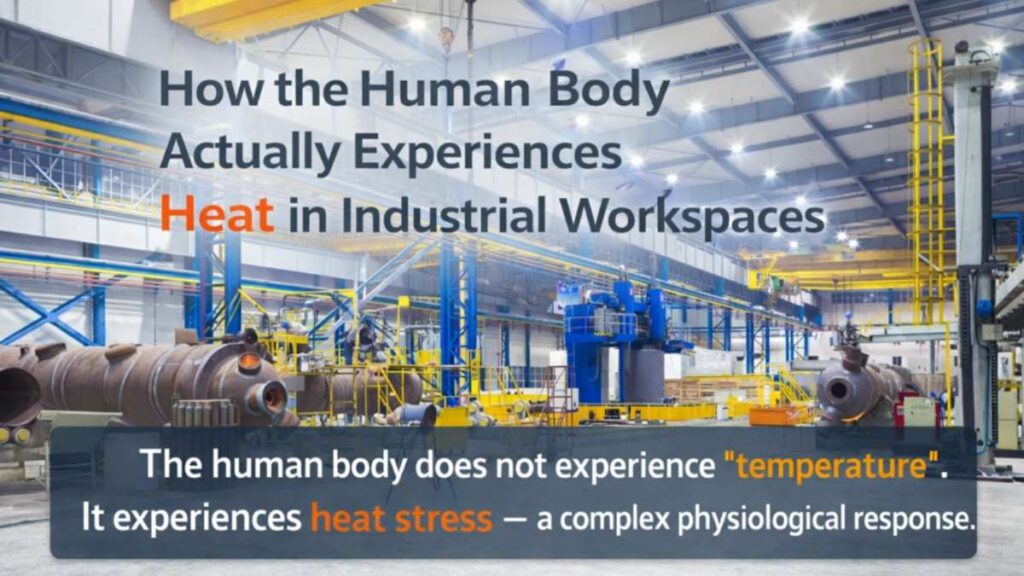
In industrial environments, heat discomfort is usually discussed in terms of air temperature. If workers feel uncomfortable, the first response is often to check the thermometer, add fans, or increase cooling capacity. How the human body experiences heat in industrial workspaces depends on a balance of radiation, airflow, humidity, and internal heat generation — not air temperature alone.
Yet many factories experience a familiar paradox: temperature readings appear acceptable, energy consumption rises, but worker discomfort persists.
The reason lies in a fundamental misunderstanding. The human body does not experience temperature alone. It experiences heat as a combined physiological load.
Understanding how the human body actually experiences heat in industrial workspaces is essential for designing environments that support productivity, safety, and operational efficiency.
Heat Is a Physiological Experience, Not a Single Number
From a human physiology perspective, the body continuously produces heat through metabolism.
To function efficiently, this internally generated heat must be released to the surrounding environment at nearly the same rate.
The human body manages heat through four primary mechanisms:
Radiation
Convection
Evaporation
Conduction (limited relevance in most industrial settings)
Discomfort arises when heat generation exceeds the body’s ability to release heat.
This imbalance is rarely caused by air temperature alone.
The Core Variable: Heat Balance, Not Ambient Temperature
The body tightly regulates its internal temperature around 37°C.
Even small deviations can affect concentration, reaction time, and physical endurance.
In industrial workspaces, excessive heat is experienced when:
Environmental conditions restrict heat loss
Work intensity increases internal heat production
Or both occur at the same time
This explains why two workers standing in the same space can experience heat very differently.
The Five Factors That Shape Heat Experience on the Shop Floor
1. Air Temperature — Important but Incomplete
Air temperature defines the baseline environment, but by itself it explains very little about how heat is actually felt.
Two areas with identical temperatures can feel completely different because air temperature:
Does not account for radiant heat
Ignores airflow quality
Does not reflect humidity or work intensity
Temperature is a necessary input, but it is not a complete explanation.
2. Radiant Heat — The Invisible Heat Load
Radiant heat occurs whenever the body is exposed to hot surfaces, regardless of air temperature.
Common industrial sources include:
Metal roofs exposed to solar radiation
Furnaces, ovens, compressors, and motors
Heated walls and machinery enclosures
Radiant heat directly increases heat gain at the body and clothing surface, often without changing thermometer readings.
This is why workers may feel excessive heat even when temperatures appear “normal.”
3. Air Velocity — How Heat Is Carried Away
Air movement governs convective heat loss and supports sweat evaporation.
However, not all airflow improves comfort.
Effective airflow must:
Reach the worker’s body
Remove warm boundary layers around the skin
Support evaporation without excessive turbulence
Poor airflow design creates thermal micro-zones, where heat perception varies across the same shop floor.
4. Humidity — The Hidden Barrier to Cooling
Sweating is the body’s most powerful cooling mechanism.
However, sweat only cools the body when it evaporates.
High humidity:
Slows evaporation
Traps heat at the skin surface
Makes moderate temperatures feel oppressive
In industrial settings, humidity often increases due to process moisture, inadequate ventilation, or insufficient exhaust systems.
5. Metabolic Load and Task Intensity — Internal Heat Production
Every activity produces metabolic heat.
Light assembly work generates minimal internal heat
Manual handling, repetitive motion, and physical labor generate significantly more
Applying the same thermal strategy across all work zones leads to overcooling in low-activity areas and insufficient cooling where physical effort is highest.
Effective heat management must align with task intensity, not just space layout.
Why Temperature-Only Approaches Fall Short
When heat issues are addressed only by lowering air temperature:
Cooling systems are often oversized
Energy consumption rises
Discomfort persists
Productivity improvements remain limited
This happens because air temperature alone cannot compensate for radiant heat, poor airflow, high humidity, or increased metabolic heat.
Heat Experience Is a System Design Challenge
Managing heat in industrial workspaces requires system-level thinking, including:
Controlling radiant heat at its source
Designing airflow paths, not just adding fans
Managing humidity consistently
Matching thermal strategies to work intensity
When heat is approached as a system problem, outcomes become more predictable, energy-efficient, and productivity-focused.
The Link Between Heat Experience and Productivity
As excessive heat exposure increases:
Reaction times slow
Error rates rise
Output consistency declines
Fatigue accumulates faster
These effects occur well before conditions become medically dangerous, leading to hidden productivity losses.
Closing Perspective
The human body experiences heat as a balance of environmental and physiological factors, not as a single temperature reading.
Industrial performance improves when:
Heat rejection is engineered, not assumed
Thermal strategies match real work demands
Energy is used where it truly improves human performance
Understanding how the human body actually experiences heat in industrial workspaces is not theoretical —
it is essential for building productive, efficient, and resilient industrial environments.
Design industrial workspaces based on how the human body actually experiences heat — not just what the thermometer shows.