
 info@fstindia.in
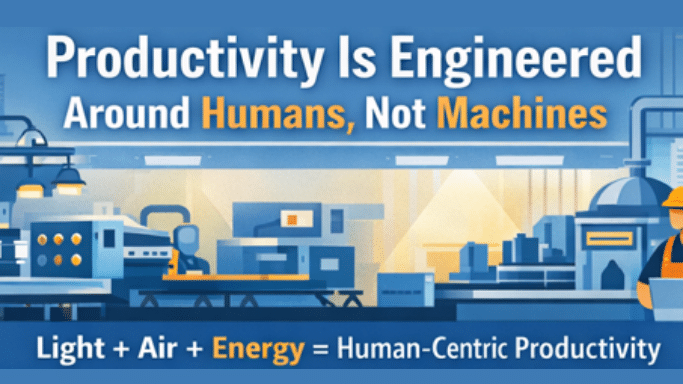
Walk into any modern factory and you will see impressive machines—CNCs, robots, conveyors, furnaces—each optimised for speed, accuracy, and uptime.
Yet, despite world-class machinery, many shop floors quietly struggle with:
- Fatigued operators by mid-shift
- Inconsistent output quality
- High error rates in the last hours of the day
- Rising energy bills with no visible productivity gain
The uncomfortable truth is this:
Productivity is not created by machines alone. It is created at the interface between machines and humans. And that interface is governed by Light, Air, and Energy.
The Industrial Blind Spot: Treating Human Environment as “Background”
Most factories engineer machines with micrometre precision, but treat the human environment as a static backdrop:
- “Lighting is installed—done.”
- “Fans are running—air is moving.”
- “Power is available—energy problem solved.”
In reality, these are not independent utilities. They are interacting systems, and together they decide how effectively humans can work with machines.
When they are engineered in isolation, productivity leaks silently—hour after hour, shift after shift.
System 1: Light — More Than Just Lux Levels
Lighting is usually discussed in terms of brightness. That’s a serious oversimplification.
On a shop floor, light affects:
- Visual clarity and defect detection
- Eye strain and cognitive fatigue
- Alertness across long shifts
Poorly designed lighting creates a paradox:
- Machines perform perfectly
- Humans miss details, slow down, or make mistakes
Even “bright” lighting can reduce productivity if glare, contrast imbalance, or uneven distribution forces the human eye to constantly adjust.
Lighting is not a fixture problem. It is a human performance system.
System 2: Air — The Invisible Productivity Multiplier
Air is often mistaken for comfort alone. In reality, it is a physiological input.
Air affects:
- Core body temperature
- Oxygen availability and CO₂ buildup
- Perceived exertion during physical work
When heat, humidity, and air movement are unmanaged:
- Reaction times slow
- Fatigue sets in earlier
- Output per worker drops—even if attendance is full
Fans, ventilation, cooling, and insulation do not work independently.
They interact dynamically with:
- Machine heat loads
- Roof and wall radiation
- Occupancy density
Ignoring this interaction means workers spend energy coping with the environment, not producing value.
System 3: Energy — The System That Ties Everything Together
Energy is rarely viewed as a productivity lever. It should be.
Every inefficiency in Light and Air:
- Forces systems to work harder
- Increases energy consumption
- Reduces controllability
For example:
- Over-lit spaces increase heat load
- Poor airflow increases cooling demand
- Uncontrolled systems waste energy without improving output
When energy is engineered without understanding human-centric demand, factories end up paying more to maintain discomfort.
The Real Problem: Systems Are Interacting, But Decisions Are Not
Here is the core issue:
- Lighting is designed by one vendor
- Ventilation by another
- Cooling by a third
- Energy by yet another
Each system may be “efficient” on paper.
But together, they often work against each other.
This is not a technology problem.
It is a system integration problem.
Productivity Emerges From Integration, Not Upgrades
True productivity improvement does not come from:
- Adding more machines
- Increasing installed capacity
- Replacing one component at a time
It comes from asking a different question:
How are Light, Air, and Energy working together around humans—across the entire shift?
When these systems are engineered as one:
- Workers sustain output longer
- Error rates drop naturally
- Energy consumption aligns with actual human need
- Productivity improves without pushing people harder
This is engineering for humans, not just for machines.
A Shift in Thinking for Modern Industry
The factories that will lead the next decade are not the ones with only the fastest machines.
They are the ones that understand:
- Humans are the most adaptive—but also the most sensitive—part of the system
- Productivity is an outcome, not a target
- Environment is not a cost centre; it is a performance platform
Machines execute.
Humans decide, adapt, and sustain performance. And how well they do that depends on how intelligently Light, Air, and Energy are integrated around them.
Final Thought
If your shop floor productivity feels capped despite good machines, ask yourself:
- Are my systems optimised individually—or engineered together for humans?
- That answer usually explains the gap.
Ready to improve shop floor productivity?
Let’s assess how your light, air, and energy systems are working together.