
 info@fstindia.in
Heat issues on industrial shop floors are rarely ignored. What is far more common, however, is acting too quickly.
Additional cooling capacity is installed.More fans are deployed. Ventilation systems are modified.
Yet despite repeated interventions, many factories continue to struggle with uneven temperatures, rising energy costs, and declining human endurance. This is not a failure of intent or investment. It is a failure of diagnostic sequencing.
Heat on the shop floor is a system phenomenon, not a single-variable problem.
Treating it effectively requires moving beyond temperature readings and adopting a structured heat diagnosis approach.
Why Temperature Alone Is a Poor Diagnostic Tool
Most heat-related decisions begin and end with temperature measurements.
While temperature is important, it is only a resultant variable—not the root cause. Two areas on the same shop floor can record identical temperatures and yet feel vastly different to workers due to airflow, radiant load, humidity, and metabolic stress.
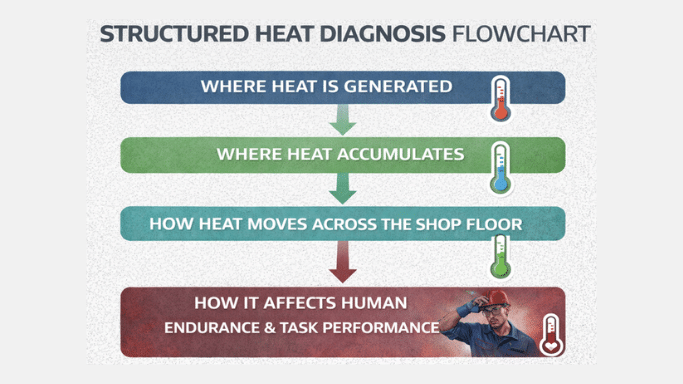
Effective diagnosis must therefore answer four deeper questions:
- Where is heat generated?
- Where does it accumulate?
- How does it move across the shop floor?
- How does it impact human endurance and task performance?
These four questions form the backbone of the Structured Heat Diagnosis Flowchart.
Step 1: Where Heat Is Generated
Heat generation is the starting point of every thermal problem.
Common industrial heat sources include:
- process equipment (furnaces, presses, ovens, compressors)
- motors, drives, and transformers
- inefficient or high-wattage lighting
- electrical losses from panels and cabling
- friction and mechanical inefficiencies
Radiant heat from machines often affects workers even when air temperature appears acceptable. This is because radiant energy transfers directly to the human body, increasing perceived heat stress without changing ambient readings.
If heat generation points are not clearly mapped, downstream interventions will always be reactive.
Key diagnostic focus:
Identify localized heat emitters, not just average conditions.
Step 2: Where Heat Accumulates
Heat does not disperse evenly.
In most factories, hot air accumulates due to:
- roof height and geometry
- insulation gaps
- structural trusses and skylights
- inadequate exhaust placement
- stratification effects
This accumulation often occurs well above working height, creating a thermal reservoir that continuously radiates heat back into the occupied zone.
As a result, cooling systems work harder while delivering diminishing returns.
Key diagnostic focus:
Understand vertical and horizontal heat storage, not just floor-level comfort.
Step 3: How Heat Moves Across the Shop Floor
Heat movement is governed by airflow behavior, not installed equipment capacity.
Typical movement issues include:
- short-circuiting of supply and exhaust air
- stagnant zones created by layout or partitionsairflow shadowing behind large machines
- conflicting air streams from fans and cooling units
When airflow paths are poorly understood, solutions unintentionally push heat from one zone to another instead of removing it from the system.
This is why many factories experience “rotating discomfort” rather than resolution.
Key diagnostic focus:
Map airflow paths and pressure zones before adding movement devices.
Step 4: How Heat Affects Human Endurance and Task Performance
Machines perform to specification. Humans do not.
Human performance degrades non-linearly with:
- sustained thermal stress
- radiant exposure
- dehydration and fatigue
- cognitive overload caused by discomfort
Even small increases in perceived heat can lead to:
- slower reaction times
- reduced precision
- higher error rates
- increased absenteeism and safety risks
This is the most overlooked step in heat diagnosis—yet it is the one that directly impacts productivity.
Key diagnostic focus:
Evaluate thermal impact at the task level, not just the zone level.
Why This Sequence Matters
When diagnosis is skipped or fragmented:
- cooling capacity increases
- energy consumption rises
- maintenance complexity grows
- comfort remains inconsistent
- productivity gains plateau
When diagnosis is structured:
- solutions become smaller and more precise
- interventions work together instead of competing
- operating costs stabilize
- human performance improves sustainably
The goal of diagnosis is not to delay action. It is to ensure that every action works in the right direction.
Conclusion: Heat Control Is a System Design Exercise
Heat issues on the shop floor are not solved by equipment alone. They are solved by understanding interactions.
At Five Star Technologies, we believe that effective heat control begins with system understanding—not symptom response.
Because on industrial shop floors, decisions made without diagnosis don’t disappear. They compound into costs for years.
