
 info@fstindia.in
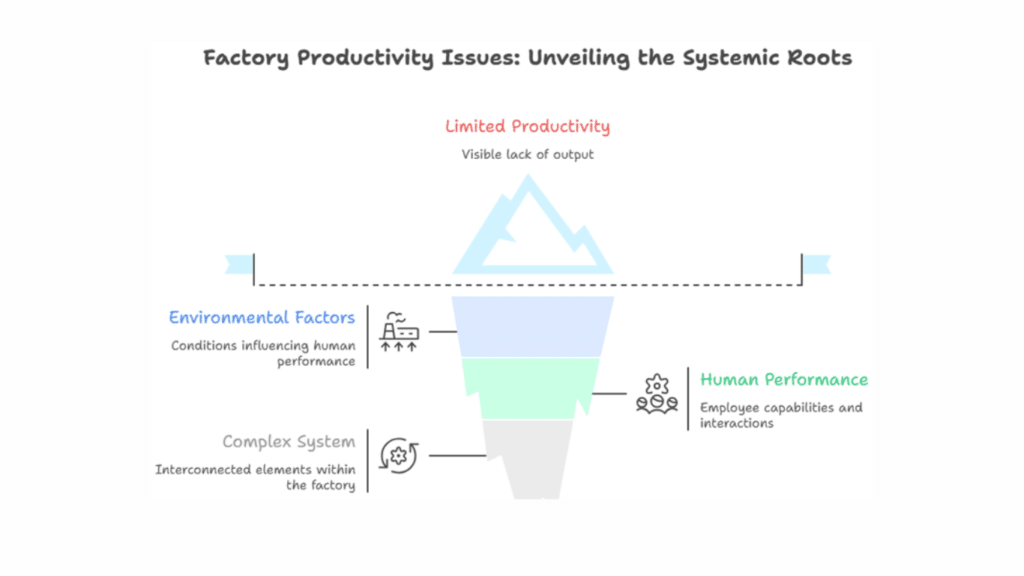
Factory productivity problems are often misdiagnosed. When output drops on a shop floor, the first instinct is to blame machines, capacity, or technology.
Equipment upgrades seem like the fastest solution. Yet many factories find that even after installing new machines, productivity barely improves. This is because most factory productivity problems are not component-level issues — they are system-level constraints.
When productivity drops on a shop floor, the diagnosis is usually immediate and confident:
The machines are old
Capacity is insufficient
Technology is outdated
Automation is missing
And so the solution feels obvious:
Upgrade the equipment.
Yet in factory after factory, the same story repeats:
New machines are installed
Capital expenditure increases
Energy consumption rises
And productivity still plateaus
This creates frustration and confusion.
If the equipment is new, why hasn’t performance improved?
The answer lies in a fundamental distinction that most factories never make:
Is the problem a component problem — or a systemic problem?
Component Problems vs Systemic Problems
Component Problems
Component problems are local and isolated.
They have:
A clear cause
A clearly defined failure
A direct, predictable fix
Example:
A motor fails → the motor is replaced → the problem disappears.
Component problems behave linearly. Fix the part, fix the problem.
Systemic Problems
Systemic problems behave very differently.
They are:
Distributed across the environment
Created by interactions between elements
Resistant to local or isolated fixes
Example:
Operators slow down even after new machines are installed.
Why?
Heat stress increases fatigue
Lighting causes visual strain
Airflow creates discomfort zones
Noise and glare increase cognitive load
In this case, replacing machines does nothing — because the machine was never the limiting factor.
Why Productivity Problems Are Usually Systemic
1. Human Performance Is Environment-Dependent
Machines perform to specification. Humans do not.
Human output varies continuously with:
Thermal stress
Visual comfort
Air quality
Noise and glare
Cognitive and physical load
A machine can run at 100% capacity in poor conditions. A human cannot.
When the environment degrades human performance, no amount of machine capability can compensate.
Productivity becomes constrained not by speed, but by endurance.
2. Equipment Upgrades Often Increase System Stress
Ironically, new machines often make systemic problems worse.
They typically:
Generate more heat
Increase lighting intensity and glare
Raise power density in confined areas
Change airflow patterns
Increase cognitive demand on operators
If the surrounding environment is not re-engineered, the system becomes more stressed, not more productive.
What looks like a technology upgrade is, in reality, a stress multiplier.
3. Bottlenecks Shift — They Don’t Disappear
Upgrading one part of the production line does not remove constraints.
It simply relocates them.
Common shifts include:
From machine speed → operator fatigue
From capacity → accuracy
From throughput → error rate
From output → recovery time
Without a system-level view, productivity gains appear briefly and then stall.
The factory feels better equipped — but not better performing.
What “This Problem Is Systemic” Really Signals
This phrase is not technical jargon. It is a mental reframe.
It shifts the conversation from:
“What equipment should we buy next?”
to:
“What conditions are limiting performance across the system?”
It forces leaders to examine:
How people interact with machines
How the environment influences effort and focus
How multiple small stressors compound into large performance losses
Why This Way of Thinking Is Different
Most vendors operate at the component level.
They say:
“Our product is more efficient.”
“Upgrade to the latest technology.”
Systemic thinking changes the narrative.
It says:
The environment is part of the production system
Human performance is a design variable
Efficiency is an outcome of system balance, not equipment count
This is not a product conversation. It is a design conversation.
The Core Insight
If productivity problems persist after equipment upgrades, the problem was never the equipment. It was the system in which the equipment operates.
Until factories start treating:
Light
Air
Heat
Space
Human physiology
as engineering variables, productivity improvements will remain:
Incremental
Unpredictable
Expensive
Why This Matters Now More Than Ever
Modern factories are denser, faster, and more complex than ever.
As complexity increases:
Small inefficiencies compound faster
Human limits are reached sooner
Environmental stress becomes a dominant constraint
Ignoring systemic factors no longer just limits growth — it actively erodes returns on capital investment.
Closing Thought
Productivity does not fail because machines are slow.
It fails because systems are unbalanced.
And systems cannot be fixed one component at a time.
To truly improve factory performance, the question must change from:
“What do we upgrade next?”
to:
“What is the system asking for?”
That shift differentiates incremental improvement from sustained performance.
