info@fstindia.in
Air circulation I Temperature control I Air Hygiene I Disinfection
AIR MANAGEMENT & VENTILATION ENGINEERING
Air Management & Ventilation Engineering
Air on an industrial shop floor is not just about moving air or reducing temperature.
It is about how heat is removed, how fresh air is introduced, how contaminants are diluted, and how the human body actually experiences comfort.
At Five Star Technologies, we engineer air management systems that improve thermal comfort, indoor air quality (IAQ), workforce productivity, and energy efficiency—by designing how air is supplied, circulated, exhausted, and controlled.
Why Air Management Is a System Problem
Most factories attempt to solve heat and comfort issues by:
Adding more fans or air coolers
Increasing cooling capacity
Running equipment longer
This often results in high energy consumption with little improvement in comfort.
Thermal discomfort is governed by multiple interacting variables:
Air temperature
Air velocity and direction
Radiant heat from roofs, walls, and machines
Humidity levels
Occupancy density and activity levels
Ignoring this interaction leads to inefficient and ineffective solutions.
Our Air Management Engineering Approach
1. Diagnose Before You Design
We begin by understanding:
Heat sources and heat trapping mechanisms
Air movement patterns and dead zones
Fresh air availability and exhaust effectiveness
Task intensity and worker exposure duration
This diagnostic approach ensures interventions address root causes, not symptoms
2. Air Movement Engineering
Effective air movement is not about fan size—it is about airflow design.
We engineer:
Directional airflow for effective heat removal
High-volume, low-speed (HVLS) air circulation where applicable
Zonal airflow based on task and occupancy
Elimination of stagnant air pockets
The objective is to enhance convective and evaporative cooling at the human level.
3. Ventilation & Fresh Air Strategy
Ventilation is critical for:
Dilution of heat, fumes, and contaminants
Oxygen replenishment
Odor and humidity control
We design ventilation systems that balance air quality improvement with energy efficiency, ensuring compliance without excessive operational cost.
4. Radiant Heat & Envelope Consideration
Air alone cannot fix radiant heat.
Our air management designs consider:
Roof and wall heat radiation
Insulation and reflective strategies
Interaction between air movement and radiant loads
This integrated approach delivers sustainable comfort, not temporary relief.
5. Controls & Smart Airflow Readiness
Air systems perform best when they adapt to real conditions.
Our designs are:
Ready for temperature, humidity, and airflow-based control
Structured for zone-wise operation
Scalable toward IoT-based monitoring and optimization
This enables continuous tuning instead of fixed, energy-wasting operation.
Outcomes We Engineer
Improved thermal comfort across shifts
Reduced heat stress and fatigue
Better indoor air quality
Lower energy consumption per unit of comfort
Stable, predictable operating conditions
Applications
Our air management solutions are engineered for:
Manufacturing and assembly floors
Warehouses and logistics facilities
Process industries
High-heat and high-occupancy environments
Anywhere people, heat, and productivity interact.

There is a complete package of modern & innovative solutions addressing the need of temp. control with highly engineered processes.
– Create fresh air by industrial air coolers – Circulate air by High Volume Low Speed Fan – Hot Air Elimination by Exhaust fans.


Germicidal UV is highly effective at getting rid of germs like viruses and bacteria. Germicidal UV, or UV-C, is already used to disinfect air, surfaces, and water. When products are used correctly, the International Ultraviolet Association (IUVA) believes UV light can inactivate COVID-19 because other coronaviruses respond to UV.
TECHNOLOGIES USED
BLDC - How it works & saves energy ?
- A BLDC fan takes in AC voltage and internally converts it into DC using SMPS. BLDC uses a combination of Permanent Magnets and Electronics to achieve the kind of efficiency and performance it delivers.
- In a BLDC motor, as there are no brushes so the commutation is done by the driving algorithm in the Electronics. Hence no wear and tear of brushes making the motor more rugged for long-term use.
- One added advantage in a BLDC fans due to use of an electronic circuit is that you can add several additional features to increase convenience, few example of the same are sleep mode, timer mode also it is compatible with Home automation systems.
- Compared to regular induction fan, a BLDC fan can save enormously upto Rs 1000-1500/ Year/fan. And because there is no heating of the motor, the life of a BLDC fan is also expected to be much higher than ordinary fans.
HVLS - How it works ?
- Ultra-Violet (UV) light is invisible to the human eye and is divided into UV-A, UV-B and UV-C.
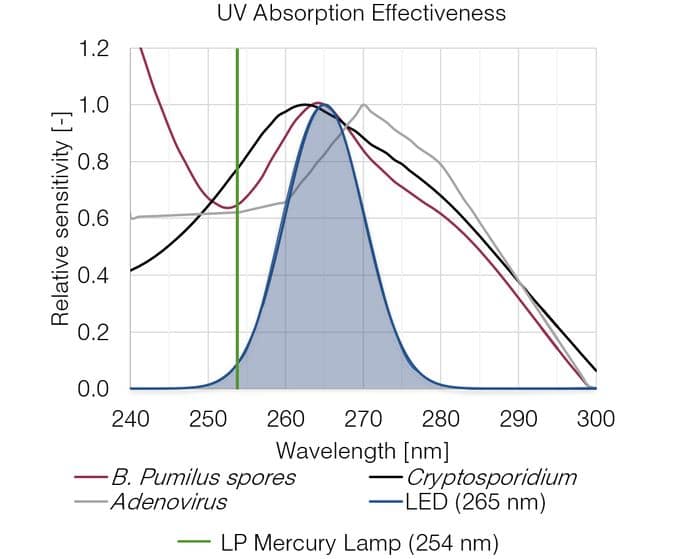
- UV-C is found within 100-280 nm range. In the graph can be seen that germicidal action is maximized at 265 nm with reductions on either side. Philips Low pressure UV-C lamps have their main emission at 254 nm where the action on DNA is 85% of the peak value and 80% on the IES curve. As a result, our germicidal lamps are extremely effective in breaking down the DNA of micro-organisms. This means that they cannot replicate and cause disease.
- Micro-organisms effective resistance to UV light varies considerably. Moreover, the environment of the particular micro-organism greatly influences the radiation dose needed for its destruction.
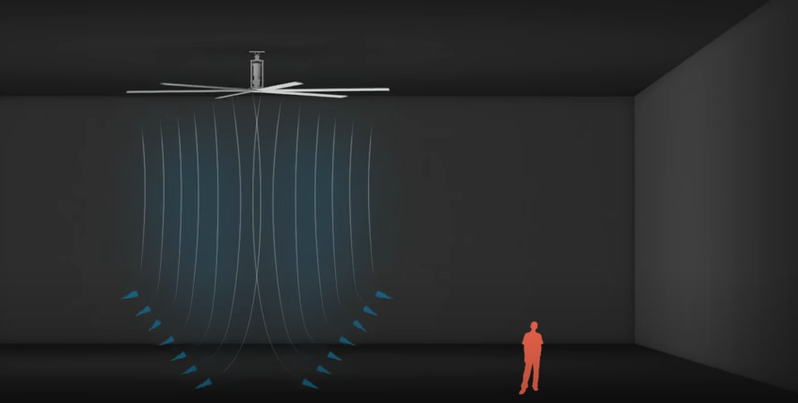
Stage-1
A column of air moves down
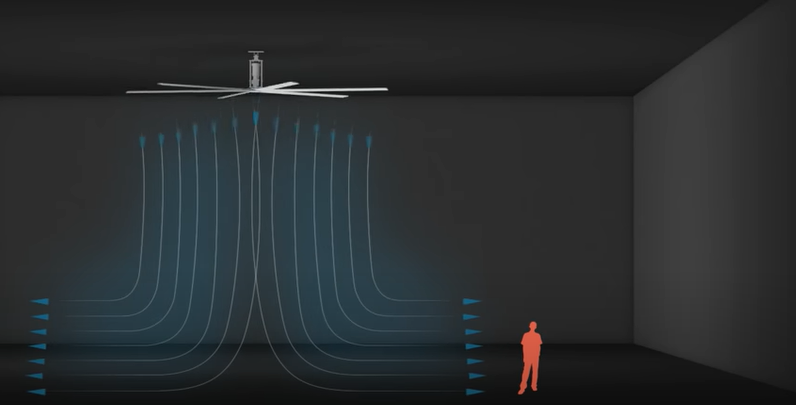
Stage-2
Air moves out from the center along the floor creating a draft .

Stage-3
Column rises up along the side walls or air draft from another HVLS fan .
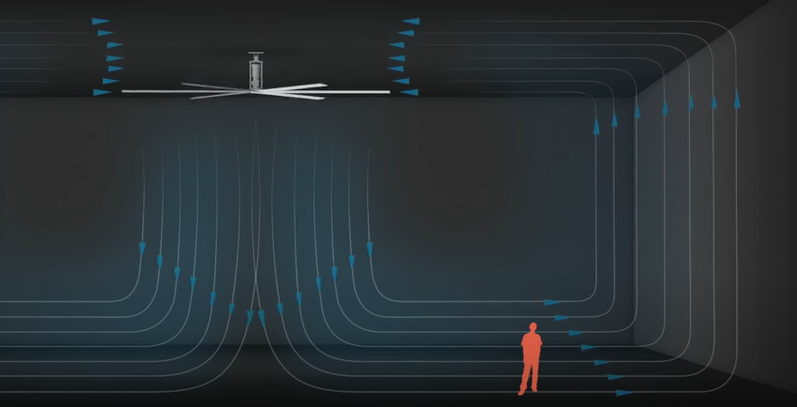
Stage-4
Air is re directed towards the HVLS fan
UV-C - How it works ?
- Ultra-Violet (UV) light is invisible to the human eye and is divided into UV-A, UV-B and UV-C.
- UV-C is found within 100-280 nm range. In the graph can be seen that germicidal action is maximized at 265 nm with reductions on either side. Philips Low pressure UV-C lamps have their main emission at 254 nm where the action on DNA is 85% of the peak value and 80% on the IES curve. As a result, our germicidal lamps are extremely effective in breaking down the DNA of micro-organisms. This means that they cannot replicate and cause disease.
- Micro-organisms effective resistance to UV light varies considerably. Moreover, the environment of the particular micro-organism greatly influences the radiation dose needed for its destruction.
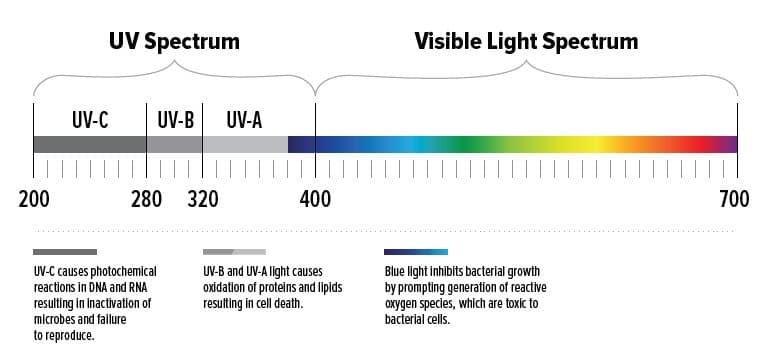
- UV-C radiation can break the DNA and RNA of bacteria,viruses and spores, meaning that they leave themharmless. There are no known micro-organisms resistant to UVC.1
- UV-C technology has been used safely and effectively in hospitals and governmental buildings for more than 40 years
- Most UV-C solutions utilize conventional lighting, with LED now improving in efficiency
- The peak output of our germicidal lamps (253.7nm) is close (80-85%) to the maximum effectiveness of UV-C (265nm)
- Smaller UV-C wavelengths (222nm) are being explored as less harmful alternatives