
 info@fstindia.in
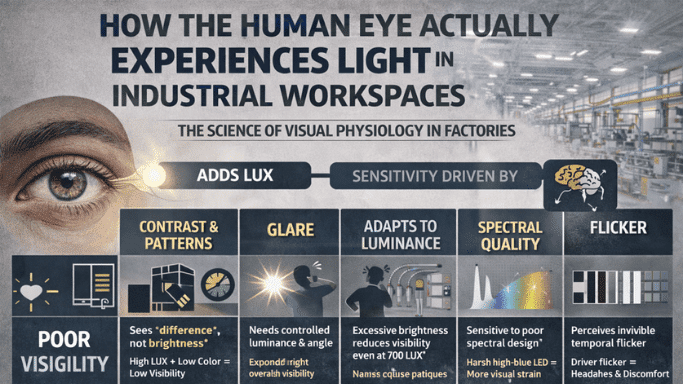
Industrial lighting and the human eye are often misunderstood in factory lighting design.
Most industrial environments still rely on a single metric—lux levels—to define lighting quality. When visibility complaints arise, the default response is to add more fixtures, increase wattage, and raise lux values.
Yet factories operating at 500–700 lux still report:
Eye strain
Visual fatigue
Inspection errors
Reduced concentration
Headaches and discomfort
The reason is fundamental:
The human eye does not experience lux. It experiences light as a biological and neurological system.
This article explains how the human eye actually experiences industrial lighting—and why many lighting designs fail when visual physiology is ignored.
The Human Eye Is Not a Light Meter
Lux measures how much light falls on a surface. The human eye, however, is a directional, adaptive, contrast-driven optical system.
Key distinction:
Lux measures surface illumination
Vision depends on how light enters the eye, adapts, contrasts, and is interpreted
The eye continuously evaluates:
Luminance patterns
Contrast ratios
Glare sources
Spectral composition
Spatial uniformity
Temporal stability
This is why two industrial areas with identical lux levels can feel dramatically different to workers.
Retinal Physiology: Rods, Cones, and Industrial Vision
Industrial work depends almost entirely on cone-dominated vision, which is highly sensitive to:
Glare
Contrast loss
Spectral imbalance
Visual adaptation stress
Simply increasing lux does not improve visual performance if these factors are poorly controlled.
Luminance, Not Lux, Governs Visual Perception
The human eye responds to luminance (cd/m²)—not horizontal illuminance.
Poor luminance control leads to:
Frequent pupil contraction and dilation
Retinal fatigue
Reduced contrast sensitivity
Increased cognitive load
A visually comfortable industrial workspace maintains controlled luminance ratios, not excessive brightness.
Contrast Sensitivity – The True Measure of Visibility
Human vision is fundamentally contrast-based, not brightness-based.
In factories:
High lux + low contrast = poor visibility
Moderate lux + high contrast = excellent visibility
This explains why inspection errors occur even in “well-lit” industrial environments.
Glare – The Silent Productivity Killer
No amount of added lux can compensate for glare.
Glare reduces:
Visual acuity
Concentration
Peripheral awareness
And directly increases fatigue and errors.
Visual Adaptation and Lighting Uniformity
Uniformity is not aesthetic—it is a neurological requirement for sustained industrial work. Poor uniformity forces constant visual re-adaptation, accelerating fatigue and reducing precision.
Spectral Quality and Visual Performance
CCT alone does not define visual quality.
Industrial lighting must balance:
Color rendering
Visual comfort
Task accuracy
Duration of exposure
Poor spectral design increases eye strain and defect detection errors.
Flicker and Temporal Instability
Even an invisible flicker stresses the nervous system and reduces hand-eye coordination—especially near rotating machinery.
Peripheral Vision and Industrial Safety
Lighting must support whole-field vision, not just task illumination, to maintain safety and spatial awareness.
Why Traditional Industrial Lighting Design Fails
Most failures occur because designs:
Optimize lux instead of luminance
Ignore glare geometry
Overlook contrast dynamics
Disregard visual physiology
Engineering Lighting for the Human Eye
Human-centric industrial lighting prioritizes:
Controlled luminance distribution
Glare management
High contrast visibility
Stable spectral quality
Uniform visual fields
Flicker-free operation
Conclusion
The human eye does not experience lighting as a number. It experiences patterns, contrasts, stability, and comfort over time. Industrial lighting must be engineered as a visual system, not just an electrical one. Lux is only the starting point.Human vision is the real design target.
Design Lighting for Human Vision, Not Just Lux
If your factory meets lux standards but still struggles with eye strain, errors, or fatigue, the problem isn’t brightness—it’s visual design.
Get a professional industrial lighting assessment based on human visual physiology. Reduce glare, improve contrast, enhance safety, and increase productivity with lighting engineered for the human eye.
