
 info@fstindia.in
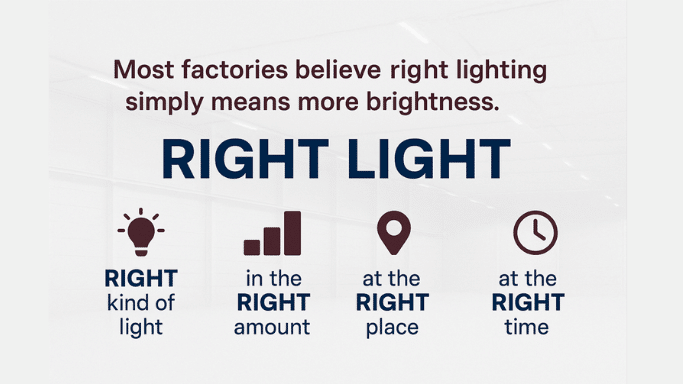
Effective industrial lighting design determines how accurately tasks are performed, how comfortable workers feel, and how efficiently operations run on the factory floor. In most industrial facilities, lighting decisions are still made using a dangerously simplistic assumption:
“If it’s bright enough, it’s good lighting.”
This assumption is not only incorrect — it’s also expensive. Factories that over-light waste energy. Factories that are under-light lose productivity, quality, and safety. And factories that use the wrong kind of light suffer from fatigue, errors, rework, and accidents — even when lux levels appear “adequate.” In industrial environments, lighting is not an electrical activity.
It is a visual engineering discipline that directly influences human performance, process accuracy, and operational efficiency. To address this systematically, global best practice increasingly follows a simple but powerful framework:
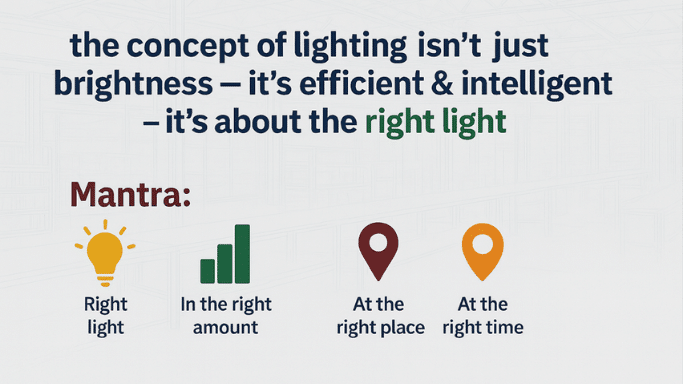
RIGHT Lighting = Right kind of light , In the right amount , At the right place, At the right time
This article breaks down this framework in technical detail and explains how it can be applied to real industrial shop floors.
Why “More Brightness” Is the Wrong Goal
Brightness alone is a poor indicator of visual performance.
Human vision depends on:
Contrast, not absolute brightness
Uniformity, not peak lux
Glare control, not wattage
Spectral quality, not color alone
Two shop floors with the same average lux can deliver completely different outcomes in terms of:
Error rates
Visual fatigue
Inspection accuracy
Reaction time
Accident probability
This is why lighting must be engineered, not guessed.
1. Right Kind of Light — Visual Quality Before Quantity
Not all light behaves the same, even if two fixtures deliver identical lumens.
Key Technical Parameters That Matter
a) Correlated Color Temperature (CCT)
Warm white (3000–3500K): comfortable but reduces alertness
Neutral white (4000–4500K): balanced for most industrial tasks
Cool white (5000–6500K): improves alertness but can increase glare if unmanaged
Engineering principle:
Match CCT to task type, not personal preference.
b) Color Rendering Index (CRI)
CRI ≥ 80: acceptable for general operations
CRI ≥ 90: essential for inspection, quality control & colour differentiation
Low CRI causes:
Misidentification of defects
False rejects or missed faults
Increased inspection time
c) Glare Control (UGR / Optics Design)
High luminance sources placed directly in the field of view cause:
Eye strain
Reduced contrast sensitivity
Increased error rates
Glare is a design failure, not a brightness problem.
d) Beam Angle & Light Distribution
Narrow beams create hotspots and shadows
Over-wide beams waste light outside task zones
Optics must be selected based on:
Mounting height
Task geometry
Machine layout
Application Examples
Assembly lines: Neutral white, low glare, controlled vertical illumination
Inspection zones: High CRI, controlled contrast, shadow-managed lighting
Warehouses: Wide, uniform distribution with high vertical illuminance for rack visibility
Wrong light increases fatigue and errors — even when lux levels are high.
2. Right Amount of Light — Lux Must Be Designed, Not Estimated
Lux levels are not arbitrary numbers.
They are defined by standards, task complexity, and visual demand.
Typical Industrial Lux Requirements (Indicative)
General movement areas: 100–200 lux
Assembly work: 300–500 lux
Fine assembly / detailed work: 750–1000 lux
Inspection & quality control: 1000–1500 lux
But average lux alone is meaningless.
Critical Engineering Metrics Beyond Lux
a) Uniformity Ratio (Emin / Eavg)
Poor uniformity causes:
Eye adaptation stress
Frequent refocusing
Reduced task speed
Uniformity is often more important than higher lux.
b) Vertical Illuminance
Humans do not work on horizontal planes alone.
Faces
Control panels
Labels
Vertical machine surfaces
Ignoring vertical illumination leads to poor visibility even when the floor lux is high.
c) Over-Lighting vs Under-Lighting
Over-lighting:
Wastes energy
Increases glare
Accelerates visual fatigue
Under-lighting:
Reduces productivity
Increases errors
Raises accident risk
Engineering goal:
Deliver task-appropriate, uniform illumination, not maximum brightness.
3. Right Place — Light the Task, Not the Ceiling
One of the most common mistakes in factories is confusing fixture placement with task illumination.
Lighting a ceiling does not mean you are lighting the work.
What Determines Correct Placement
Machine geometry
Task height
Worker posture
Movement paths
Shadow-casting elements
Common Design Errors
Fixtures placed symmetrically for aesthetics, not function
Light blocked by cranes, ducts, or tall machines
High-bay fixtures delivering light where no task exists
Ignoring the shadow zones created by the equipment
Correct Engineering Approach
Identify visual task zones
Design lighting to deliver illumination at task height
Control shadow direction and contrast
Ensure vertical and horizontal illumination balance
Correct placement often reduces fixture count while improving visibility.
4. Right Time — Static Lighting in a Dynamic Factory Is a Design Failure
Factories do not operate under constant conditions.
Shifts change
Daylight varies
Processes start and stop
Zones remain idle for hours
Yet many factories run all lights at full output, all day.
This is where controls and automation become essential.
Technologies That Enable “Right Time” Lighting
Occupancy sensors
Daylight sensors
Zonal switching
Dimming controls
Time-based schedules
Integrated lighting automation systems
Benefits of Dynamic Lighting
Reduced energy consumption
Extended luminaire life
Improved visual comfort
Lighting aligned with actual usage
Lighting should respond to operations — not ignore them.
Integrating the Framework — Lighting as a System, Not a Product
The RIGHT framework only works when lighting is treated as a system, not a collection of fixtures.
A proper industrial lighting design process includes:
Site study and task mapping
Standards-based lux planning
Optical selection
Simulation and validation
Control strategy integration
Post-installation verification
Skipping any step compromises performance.
Measurable Outcomes of RIGHT Lighting
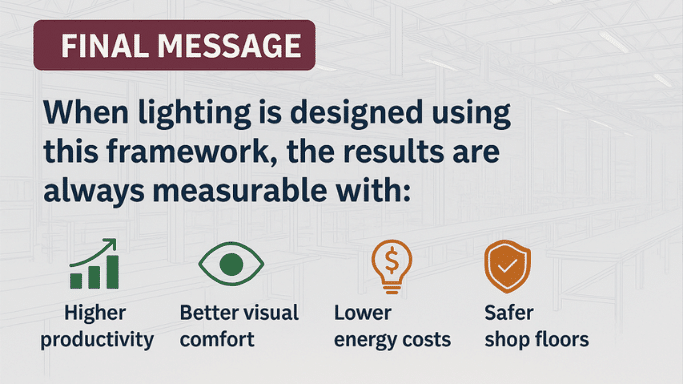
Factories that implement lighting using this framework consistently report:
Higher productivity due to reduced visual fatigue
Better quality from improved inspection accuracy
Lower energy costs from optimized lux and controls
Safer shop floors with reduced glare and shadow hazards
Longer equipment life through lower thermal stress
These are not theoretical benefits — they are measurable operational gains.
Final Perspective: Lighting Is an Engineering Decision
Lighting decisions shape:
How people see
How fast they work
How accurately they perform
How safe the environment is
That makes lighting a productivity system, not a utility expense.
Always remember:
Lighting is not an electrical activity – It is a human-centric engineering decision.
Design the light right — and factory performance follows.
Want to know whether your factory lighting is RIGHT — or just bright?
Book a professional lighting assessment and redesign based on task analysis, standards, and real shop-floor data.
