
 info@fstindia.in
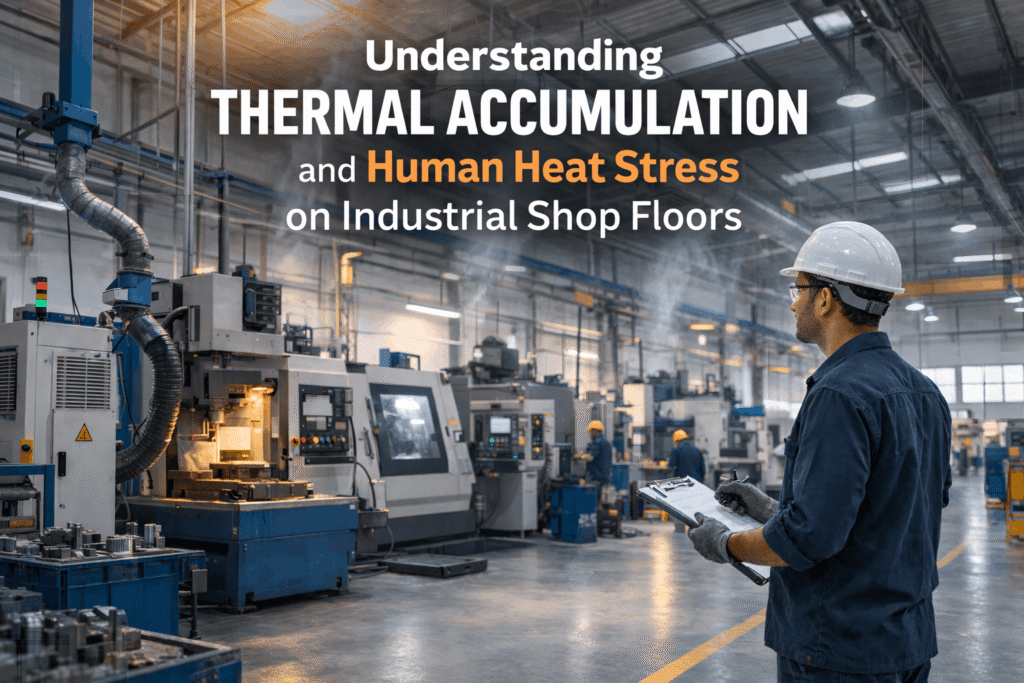
Many factories report a recurring pattern. In the morning, the shop floor feels reasonably comfortable. Machines start operating, workers settle into production, and the environment appears manageable.
But by mid-afternoon, something changes. Operators begin to complain about the heat. Fatigue increases. The air feels heavier and more stagnant.
Productivity often slows during the latter half of the shift.
Interestingly, this phenomenon occurs even when the ambient outdoor temperature has not increased dramatically. The reason is not simply higher afternoon temperature.
The real cause is thermal accumulation combined with human heat stress dynamics inside industrial buildings. Understanding this requires examining how heat behaves inside large manufacturing spaces over time.
The Physics of Heat Accumulation in Industrial Buildings
Factories are large thermal systems that absorb, store, and redistribute heat throughout the day.
Several heat sources contribute simultaneously:
- Solar radiation through the roof and walls
- Heat released from machinery and industrial processes
- Lighting heat load
- Human metabolic heat
- Outdoor air entering through ventilation systems
Unlike outdoor environments, factories often have limited mechanisms for rapid heat dissipation. As a result, heat gradually accumulates within the structure.
This accumulation explains why afternoon conditions feel significantly worse than morning conditions.
Morning: Low Initial Thermal Load
At the beginning of the day, the building starts from a relatively low thermal baseline.
During the night:
- Solar radiation is absent
- Machine operations stop
- Internal heat dissipates slowly through ventilation and structural conduction
By morning, the building envelope—roof, walls, and internal air mass—has cooled to a lower temperature.
When production begins:
- Heat generation starts gradually
- Thermal load builds slowly
Workers therefore experience a relatively moderate environment. However, this balance changes as the day progresses.
Solar Radiation and Roof Heat Gain
One of the largest contributors to industrial heat is solar radiation on metal roofs. Metal roofing systems have high thermal conductivity and relatively low thermal resistance.
During daylight hours, solar radiation heats the roof surface significantly. Typical roof surface temperatures can reach:
60–70°C under direct sunlight.
This heat then transfers into the building through two mechanisms:
Conduction
Heat travels through the roof material into the interior structure.
Radiant Heat Transfer
The hot roof radiates thermal energy downward into the shop floor space. This process continues throughout the day, gradually increasing the internal heat load. By afternoon, the roof structure itself becomes a large thermal radiator.
Heat Stratification in High Roof Factories
Industrial buildings often have roof heights ranging from 8 to 15 meters or more. When internal heat sources operate, warm air rises due to lower density.
This leads to thermal stratification, where hot air accumulates near the roof. Over time, this creates a heat layer or thermal reservoir above the working zone.
As the day progresses:
- The heat layer thickens
- Temperature near the roof continues to rise
Eventually, this stored heat begins to radiate downward and mix with lower air layers. This contributes significantly to worsening thermal conditions during afternoon hours.
Continuous Process Heat
Industrial processes continuously release heat throughout the production cycle.
Examples include:
- Injection molding machines
- Furnaces
- Welding operations
- Compressors
- Hydraulic presses
- Motors and drives
Each machine may release a modest amount of heat individually.
However, across an entire shop floor with multiple machines operating simultaneously, the cumulative heat load becomes substantial. Because factories often operate for 8–12 hours continuously, this heat steadily increases the internal thermal mass of the building.
By afternoon, the accumulated heat from machinery significantly raises the indoor temperature.
Lighting Heat Contribution
Even efficient LED lighting systems convert a portion of electrical energy into heat. In large factories with hundreds of fixtures operating simultaneously, this heat contribution becomes noticeable.
Over several hours of continuous operation, lighting adds to the internal thermal load. While lighting heat alone may not dominate the heat balance, it contributes to the overall thermal accumulation effect.
Reduced Heat Dissipation Efficiency
Ventilation systems often remove heat through air exchange.
However, several limitations reduce the effectiveness of heat removal:
- Low air exchange rates
- Poor airflow distribution
- Obstructions caused by machinery layout
- Inadequate roof-level exhaust
As the internal heat load increases during the day, ventilation systems may not remove heat at the same rate at which it is generated. This results in gradual heat buildup.
By afternoon, internal temperatures can exceed outdoor temperatures in many factories.
Human Thermal Stress in the Afternoon
The worsening perception of heat is not only due to higher temperatures.
Human physiology also plays a role.
Workers engaged in physical tasks generate metabolic heat, which must be dissipated through:
- convection
- evaporation (sweating)
- radiation
As environmental temperatures increase and air movement decreases, the body’s ability to dissipate heat reduces.
In the afternoon:
- workers have already accumulated several hours of metabolic heat
- dehydration may begin to affect thermoregulation
- fatigue reduces tolerance to thermal discomfort
Even small increases in environmental temperature can significantly increase perceived heat stress.
The Combined Effect
By mid-afternoon, multiple factors converge:
- Roof heat radiation peaks
- Heat stratification intensifies
- Machine heat accumulates
- Lighting heat continues
- Ventilation struggles to remove excess heat
- Workers experience physiological fatigue
The environment becomes thermally unstable.
As a result, the shop floor feels significantly hotter—even if the measured air temperature increases only moderately.
The Engineering Insight
Afternoon heat in factories is not simply a weather problem.
It is the result of thermal accumulation inside a large industrial structure combined with continuous heat generation and limited heat dissipation.
Without addressing how heat enters, moves, and accumulates inside the building, discomfort will increase as the day progresses.
Understanding these thermal dynamics is essential for designing factories that maintain stable environmental conditions throughout the working day.
Because sustainable productivity on the shop floor ultimately depends not only on machines—but on the environment in which people operate them.
