
 info@fstindia.in
A Physiological, Thermodynamic & Environmental Engineering Perspective
Human heat sensation is not determined by air temperature alone. Instead, it emerges from a complex interaction between human physiology, heat transfer mechanisms, neuro-sensory signalling, and environmental conditions.
This article explains—at a fundamental level—why the human body feels heat, how that sensation is generated, and why cooling strategies fail when they ignore the physics of human thermoregulation.
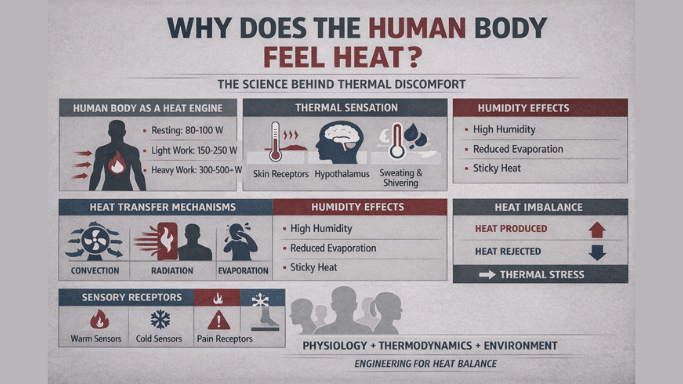
1. The Human Body as a Heat Engine
The human body functions as a continuous internal heat generator.
Average Metabolic Heat Production
Resting adult: ~70–100 W
Light industrial work: 150–250 W
Heavy manual labor: 300–500+ W
This heat is produced through cellular metabolism, primarily ATP hydrolysis in muscles and organs. To maintain enzyme stability and neurological function, the body must keep its core temperature within a narrow range (36.5–37.5°C).
Any excess heat must be rejected to the environment. When heat rejection becomes inefficient, heat accumulates, leading to discomfort, fatigue, and physiological stress.
2. Human Thermoregulation: The Body’s Control System
Human thermal regulation operates as a closed-loop biological control system:
Sensors: Thermoreceptors in skin and deep tissues
Controller: Hypothalamus (central thermal regulator)
Actuators:
Vasodilation / vasoconstriction
Sweating
Shivering
Behavioral responses (movement, posture, clothing adjustment)
Key Insight:
Thermal discomfort begins at the skin, not the core. The body often feels hot long before core temperature rises.
3. Heat Transfer Mechanisms Governing Thermal Sensation
Human heat exchange occurs through four fundamental modes of heat transfer.
3.1 Conduction (Limited in Air)
Heat transfer through direct contact (floors, chairs, machinery)
Negligible in open air
Significant in seated workstations or contact-heavy industrial tasks
3.2 Convection (Dependent on Air Movement)
Convective heat loss depends on:
Air temperature
Air velocity
Skin–air temperature gradient
Low air velocity: Stagnant boundary layer → poor heat dissipation
High air velocity: Boundary layer disruption → enhanced cooling
This explains why fans improve comfort even when air temperature is high.
3.3 Radiation (The Most Ignored Factor)
Radiant heat exchange occurs between the human body and surrounding surfaces.
Critical fact:
In still air, the human body often exchanges more heat radiatively than convectively. If roofs, walls, or machinery are hot, the body absorbs radiant heat, even when air temperature is moderate.
Real-world implications:
A factory at 32°C with a hot roof feels worse than one at 35°C with insulated surfaces
Shade dramatically improves outdoor thermal comfort
3.4 Evaporation (Sweating Efficiency)
Evaporation becomes the only effective cooling mechanism when air temperature approaches or exceeds skin temperature (~34°C).
Efficiency depends on:
Relative humidity
Air velocity
Skin wettedness
High humidity: Evaporation suppressed
Low airflow: Sweat stagnation
Result: Sweat drips but does not cool, creating intense discomfort.
4. Skin Thermoreceptors: Why Heat Is Felt Locally
The skin contains specialized nerve endings:
Warm receptors: 30–45°C
Cold receptors: 10–35°C
Nociceptors: Extreme temperatures (pain)
Key Characteristics
Uneven distribution across the body
Higher density on face, neck, and chest
Respond rapidly to temperature change (ΔT), not just absolute temperature
This explains:
Why radiant heat on the face feels unbearable
Why sudden airflow gives instant relief
Why discomfort occurs even when air temperature is stable
5. Humidity: The Latent Heat Trap
Humidity does not add heat—it prevents heat removal.
At high relative humidity:
Vapor pressure gradient collapses
Sweat evaporation slows
Latent heat is not extracted
The body continues generating heat, but its primary cooling pathway is blocked.
This creates sensations described as:
“Sticky heat”
“Suffocating”
“Sweating without relief”
6. Metabolic Load vs Environmental Load
Thermal discomfort occurs when:
Heat Produced > Heat Rejected
This imbalance is caused by:
High metabolic activity
Poor ventilation
High radiant temperatures
Low air movement
High humidity
Insulating clothing or PPE
Industrial PPE Effects
Increases thermal resistance
Reduces evaporative cooling
Traps hot microclimates near skin
7. Why Air Temperature Alone Fails as a Comfort Metric
Air temperature is only one variable in thermal comfort.
True human thermal sensation depends on:
Air temperature
Mean radiant temperature
Air velocity
Relative humidity
Metabolic rate
Clothing insulation
This explains why:
24°C air-conditioned spaces can feel hot
32°C warehouses with airflow feel acceptable
Cooling systems fail without airflow or radiation control
Modern comfort models (PMV/PPD, Adaptive Comfort) reflect this multidimensional reality.
8. Psychological and Neural Amplification of Heat
Heat perception is also neurological and psychological.
Factors that amplify discomfort:
Visual glare and bright sunlight
Noise and cognitive stress
Fatigue and dehydration
Lack of environmental control
The brain integrates thermal, visual, auditory, and emotional inputs into a single comfort response.
Conclusion: Heat Is Felt When Physics Defeats Physiology
The human body feels heat when:
Internal heat generation exceeds heat rejection capacity
Heat transfer pathways are restricted or reversed
Sensory receptors detect adverse gradients
The nervous system triggers protective stress responses
True thermal comfort requires integrating physiology, thermodynamics, and environmental engineering—not just lowering air temperature. In industrial environments, designing for human heat balance is the difference between regulatory compliance and real productivity.
Struggling with heat despite air-conditioning?
Real comfort comes from airflow, radiation control, and human-centric thermal engineering — not just lower temperatures. Talk to our experts and design a workplace that actually stays cool.
