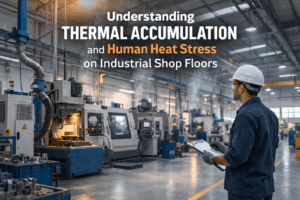
Introduction: The Strange Case of “Hotter Inside Than Outside”
Walk into your factory at 2 p.m., and you’ll often hear:
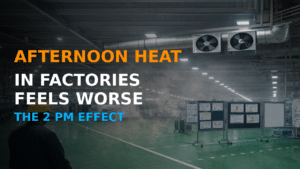
“It’s hotter inside than outside!” And it’s true. Even when the outdoor temperature is 38°C, many shop floors reach 45–48°C.
Machines may not have changed, but airflow, heat buildup, and radiant heat certainly have.
Let’s understand why this happens — and how to solve the factory heat problem scientifically using smart industrial ventilation solutions.
Trapped Heat Zones — The Hidden Culprit

Factories often act like heat containers, trapping hot air inside. As warm air rises, it collects near the roof, especially when the building lacks proper exhaust vents. By afternoon, this trapped air forms a heat blanket that radiates downward, making the factory floor even hotter.
Common Signs of Trapped Heat in Factories:
Temperature difference between floor and roof > 5°C
Persistent heat even after sunset
Workers complain of fatigue or “stuffy air”
Solution: Improve Natural Exhaust Flow
Add ridge ventilators or roof-mounted exhausts to release hot air and promote upward airflow.
This simple factory cooling system step prevents heat buildup and keeps the shop floor comfortable.
Poor Air Movement Across the Shop Floor

Fans alone don’t guarantee effective ventilation.
If air only moves in circles, it fails to bring in fresh air and doesn’t reduce factory temperature.
You Need:
Cross ventilation with inlet and outlet points on opposite walls
Correct Air Changes Per Hour (ACPH) based on your process
HVLS fans or air circulators for uniform airflow
Factories with efficient industrial ventilation solutions can feel 5–7°C cooler — even without air conditioning.
Radiant Heat from Roofs and Machines
Even with good airflow, radiant heat continues to add thermal load.
Metal roofs absorb sunlight and radiate heat downward, while machines, compressors, and ovens emit intense local heat. This can raise the workspace temperature by another 4–6°C.
Solution: Block Radiant Heat
Use reflective roof coatings, insulation panels, or radiant barriers.
These reduce trapped heat in factories and make your factory cooling system more effective.
The Vicious Cycle: Heat → Fatigue → Productivity Loss
Excessive heat doesn’t just cause discomfort — it kills productivity.
Research shows every 1°C rise above 27°C reduces worker output by 2–3%.
That means a 6°C increase equals up to 15% productivity loss.
Other Effects of Factory Heat Problems:
Slower reaction times
Higher error rates
Increased absenteeism
More machine breakdowns
By controlling temperature and airflow, you can protect both people and machines.
The Smart Fix — Manage Air, Not Just Temperature
You don’t always need expensive air conditioning.
What you really need is smarter airflow design to naturally reduce factory temperature.
Our Approach:
On-site heat and airflow survey
Mapping of heat zones and stagnant areas
Ventilation and air-circulation redesign
Radiant heat reduction with insulation and reflective surfaces
Result:
5–8°C drop in effective temperature
20–25% higher worker comfort
Better process stability and longer equipment life
With the right industrial ventilation solution, your factory can stay cooler, more efficient, and more productive.
Book Your Free Heat Issue Survey
Not sure why your factory feels hotter than outside?
Let’s find out together.
Our experts will:
- Identify trapped heat zones and radiant sources
- Check airflow and ventilation efficiency
- Recommend low-cost, high-impact solutions Let’s make your shop floor cooler, healthier, and more productive — without wasting energy.

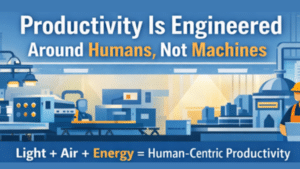
Productivity is not a function of machines alone.It is a function of how Light, Air, and Energy are engineered around humans
Walk into any modern factory and you will see impressive machines—CNCs, robots, conveyors, furnaces—each optimised for speed, accuracy, and uptime. Yet, despite world-class machinery, many

A Structured Heat Diagnosis Framework for Industrial Shop Floors
Heat issues on industrial shop floors are rarely ignored. What is far more common, however, is acting too quickly. Additional cooling capacity is installed.More fans

Differentiate: Why Factory Productivity Problems Are System level — Not component level
Factory productivity problems are often misdiagnosed. When output drops on a shop floor, the first instinct is to blame machines, capacity, or technology. Equipment upgrades

How the Human Body Actually Experiences Heat in Industrial Workspaces
In industrial environments, heat discomfort is usually discussed in terms of air temperature. If workers feel uncomfortable, the first response is often to check the

How the Human Eye Actually Experiences Light in Industrial Workspaces
Industrial lighting and the human eye are often misunderstood in factory lighting design.Most industrial environments still rely on a single metric—lux levels—to define lighting quality.

Lighting Is Not Brightness: Why More Lux Does Not Guarantee Better Visibility on Shop Floors
Introduction In industrial environments, lighting decisions are often reduced to one metric: lux levels. If an area feels poorly lit, the solution seems obvious—add fixtures


Informative ..